"These resources represent what I feel is a new literacy genre: Publishers’ Pages... Whatever one’s comfort level with technology, for classes of students who are not natural print loving readers this is a genre of content that will work wonders."

I’m a mature baby-boomer educator whose relationship
to books stands in sharp contrast to that of so many of the young students I
meet. A reader from age 3, I amassed my
own personal library of treasured books; I never lacked for titles I wanted
to read. In school, because of the personal
passion I had for books, I was ready and eager to read required work
thoroughly. And while I may not have
liked everything assigned, I was always ready to read what was set before me.
Fast forward to growing numbers of students I
encounter, currently. 21st century youngsters entering middle
schools with little or no interest in fiction or non-fiction, be it suggested
independent or class text reading.
As a veteran teacher of ELA I’m focused on this
challenge as I am in identifying approaches that will better enable my younger
and less experienced colleagues to interest young readers in what I personally know
to be compelling works of literature; ones with valuable life and craft
lessons.
But I also marvel at the scope and significance of
the challenge as there are now so many students who, while bright and engaged
in various content learning and career goals, still do not see the necessity of
reading literary works for any purpose, whatsoever.
These are students who go online routinely to research
and learn how to do tasks and learn skills by watching and note taking from
videos. How do I get them to give reading of a print book that the entire class
will be reading and discussing, a chance?
This is not only an issue for me, an adult ELA
teacher who races to the library to reserve newly published books and still,
after decades of teaching, keeps a list of the independent reading to do each
month; this is an issue facing all ELA teachers who work with students who have
never identified as readers and feel reading is not necessary for the career or
personal life they will pursue.
Ironically, the answer to this question lies
precisely in the online resources these non book readers regularly frequent,
something they do often and with gusto without being assigned to so by
their teachers.
Even more
ironic, I and other print book readers of all ages have been making strong use of similar resources as part of our
print reading for at least a decade.
What are these resources? Publisher Pages
and Book Trailers!
Publishers’ Pages
are online pages produced by publishers for various book titles. The publisher shares the title and usually
provides (minimally) an excerpt of the print book and often an excerpt from the
audio version, and generally an enlarged version of the book cover. And,
of course, they represent a bit of a pitch to potential purchasers. Not
every publisher offers these and those that do, not necessarily for every book.
For a class that may be used to perusing these, the lack of one can motivate
student readers to produce their own facsimile.
A BOOK TRAILER mimics a movie trailer in that it is an
online promo for a particular book. Often it is a 90 second or under video or
animation. It usually focuses on presenting the themes of the book,
exciting plot twists or characters or the reputation of the author, if well
known. Like movie trailers, depending on the artistry and resources the
publisher or producer of the trailer puts into it, these trailers may be
successful in attracting target student and adult readers to the book.
But even their failure can be a point of discussion with students. Of
course, when an author is a new one or has never had big sales publishers may
not offer these. The lack of a trailer for certain books opens the way
for students to create their own trailers. These are often done as book report
alternatives and sometimes students send them to authors.
Recently, I introduced 4 series books of Jason
Reynolds rich and accessible 'Track' series to middle school readers – Titled: Ghost,
Patina, Sunny and Lu- (Simon and Schuster, 2016-2018), I was well aware of the
fact that the majority of this Title 1 class, comprised of students not reading
on grade level according to standardized tests, were not book readers.
I realized as I planned ways to engage them in the books’
stories of four very authentic middle school track team runner characters (Reynolds presents one character in each of the series’
titles) that I needed something visual to hook the students before the usual,
“relating” per-discussion, book talk I have before one of my classes begins any text
that will be studied.
A reader and fan of Jason Reynolds personally, and seeking
to find ways to engage student readers in Reynolds’ work, I quickly went to the 'Publishers’ Pages' for these
books. They immediately seemed to have great
potential, offering highly engaging
instructional resources. I’ve included links to the pages below:
https://www.simonandschuster.com/books/Patina/Jason-Reynolds/Track/9781481450195
https://www.simonandschuster.com/books/Ghost/Jason-Reynolds/Track/9781481450164
https://www.simonandschuster.com/books/Ghost/Jason-Reynolds/Track/9781481450164
Each of these pages offers a link to a common, easily accessible
and engaging animated trailer of the serues of four runners books. This takes the form of a short, captivating animated narrative that introduces each of the runners characters.

I had selected Jason Reynolds for the class because I knew he had the rare gift to give authentic voice to diverse, middle school characters in all the complexity of their emotional inner lives, as well as the societal, racial, cultural and political challenges they faced. And I had found what I knew would help me engage my students in these works. But, beyond that, I also realized as I went through the very simple “See, Listen, and Read" excerpts format of the publishers pages, that here was a new digital literacy genre to enthrall reluctant students, luring them into giving these works and their characters a chance.
https://www.simonandschuster.com/books/Ghost/Jason-Reynolds/Track/9781481450164
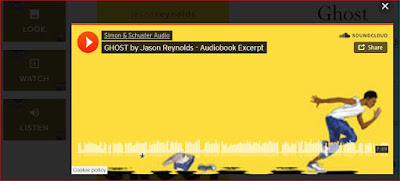
First, we watched the short, animated trailer found on the publishers pages (labeled “Watch”) and talked about how it paralleled the type of real movie trailer one would see at the local cinema; how it previews the content and style of the full work. Its goal is to make potential readers want to read the work to find out whether or not it satisfies their expectations about its plot, characters, mood, and style. The students viewed the trailer with me twice and listed character details including personality, life issues, and runner position on the track team, which they anticipated from watching the trailer. They were encouraged to make at least 10 or more predictions.
First, we watched the short, animated trailer found on the publishers pages (labeled “Watch”) and talked about how it paralleled the type of real movie trailer one would see at the local cinema; how it previews the content and style of the full work. Its goal is to make potential readers want to read the work to find out whether or not it satisfies their expectations about its plot, characters, mood, and style. The students viewed the trailer with me twice and listed character details including personality, life issues, and runner position on the track team, which they anticipated from watching the trailer. They were encouraged to make at least 10 or more predictions.
Next we listened to the audio excerpt provided for
Ghost (labeled “LISTEN), which is the first book in the series.
Prior to that I asked the students to share
nicknames they had within their family or had been given by friends or they had
created on their own. They
talked about why they liked or disliked these and how use of these
nicknames influenced their mood and sense of belonging or not. Of course, we also discussed the extent to
which some nicknames given by others for individual groups or students can be
helpful or not. Some of the students on their own shared “hateful” nicknames
used outside of school and inside of school but away from teacher's hearing.
We talked about what the nickname “Ghost” might
indicate. The students voiced their
predictions which were recorded (as text.)
As we listened to the short Ghost audio excerpt, I also asked the students to make predictions based on their listing of personal details about Ghost, the main character, about his strengths, fears, and hopes.
As we listened to the short Ghost audio excerpt, I also asked the students to make predictions based on their listing of personal details about Ghost, the main character, about his strengths, fears, and hopes.
These were shared aloud and listed with the date so
the students could check later on the extent to which they had correctly anticipated Jason
Reynolds plot and character development.
We also talked a bit about how there are infinite ways an author can
develop a character… and even if some of the student predictions didn’t turn
out to align with the way that Ghost really was written, it did not mean that
they could not develop alternate plot lines for the character, themselves.
Finally, we focused on the design of the book’s
cover shown on the publisher’s page.
The students listed visual details from the design
and what information about the key character, the plot, and author’s purpose
they could infer from it.
This was of course a ‘cover walk’ (see: ‘Book/Picture
Walk’) , which is part of best practices for younger elementary readers. I emphasized that this was a selling
tool for the publisher to get teachers and readers of all ages to
purchase the book. The students voiced
details they inferred from the design and described how they connected this
concrete visual data to the book plot and to the main character. Importantly, they were making brief arguments
for this connection.
Of course, students can, beyond voicing their views
and reviews about the trailers on a publisher page, also create their own video
promos for a book after reading it, perhaps even panning it, for
their school web site or school podcast.
They can also be producers of their own audible excerpts, which would be a
very appropriate student product, for works like this Reynolds series or others
which have characters who are of the same age and demographics as student
readers. There is a beautiful
naturalness in having students read these aloud and record, using their own
voices, some of the text of books which “voice” their lives.
Reflecting back on all of this, I can see that these resources represent what I feel is a new literacy genre: Publishers’ Pages. While teachers who are members of the ‘Technology Power Users” ilk might overlook the high value of these pages due to their simplicity and ease of use, that is precisely what makes them extremely useful. For teachers who are still getting comfortable with using technology in the context of addressing important instructional goals, this is a perfect resource type. But, whatever one’s comfort level with technology, for classes of students who are not natural print loving readers this is a genre of content that will work wonders.
Reflecting back on all of this, I can see that these resources represent what I feel is a new literacy genre: Publishers’ Pages. While teachers who are members of the ‘Technology Power Users” ilk might overlook the high value of these pages due to their simplicity and ease of use, that is precisely what makes them extremely useful. For teachers who are still getting comfortable with using technology in the context of addressing important instructional goals, this is a perfect resource type. But, whatever one’s comfort level with technology, for classes of students who are not natural print loving readers this is a genre of content that will work wonders.
Here are some sample publishers pages for other
current middle school books which are good examples of the genre:
The Poet X- Elizabeth Acevedo
With Fire on High- Elizabeth Acevedo
The Honest Truth - Dan Gemeinhart-
How It Went Down-Kekla Magoon
Jabberwalking- Juan Felipe Herrara
..............................................................................................................................................
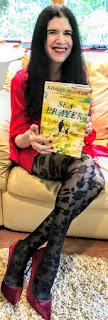
Dr. Rose Reissman is
the founder of the Writing Institute, now replicated in 200 schools including
PS 205 in The Bronx, New York City. She is a featured author in New York
State Union Teachers Educators Voice 2016 and was filmed discussing ESL student
leadership literary strategies developed at Ditmas IS 62, a Brooklyn public
intermediate school. Ditmas IS 62 is under the leadership of Marielena Santiago
Principal and Michelle Buitrago AP. The Writing Institute Team are: Michael
Downes, Angelo Carideo, and Amanda Xavier.
Contact: roshchaya@gmail.com
Contact: roshchaya@gmail.com


