Thursday, January 9, 2020

Living and Learning with Robots… NOW!


Living and Learning with Robots… NOW! 

How do today’s young students understand the potential of robots in their world? Actual robots, that is, robots they increasingly will encounter in their home and neighborhood, in the world of work and commerce, and in school, as well.


Along with a teacher colleague, Dr. Rose Reissman took on this powerful, relevant and very timely foray into bringing a controversial and important real world theme into Language Arts and Social Studies oriented learning activities.

At Ditmis Middle School (Brookly, NYC) Reissman collaborated with Ms. Amanda Xavier to introduce the topic Xavier’s 4 ELA 6th grade partnered classes. These include three enrichment classes and an ICT group.  

Here’s quick rundown of what the 2 educators did with the students. This short segment is followed by Reissman’s in-depth article on how colleague teachers everywhere can similarly bring this important approach to their students.
|

First Session: The topic was connected thematically with the 1950 Ray Bradbury short story ‘The Veldt’  which focuses on children's addiction to a multi-sensory telepathically controlled "nursery" with lethal consequences to the parents of the children.


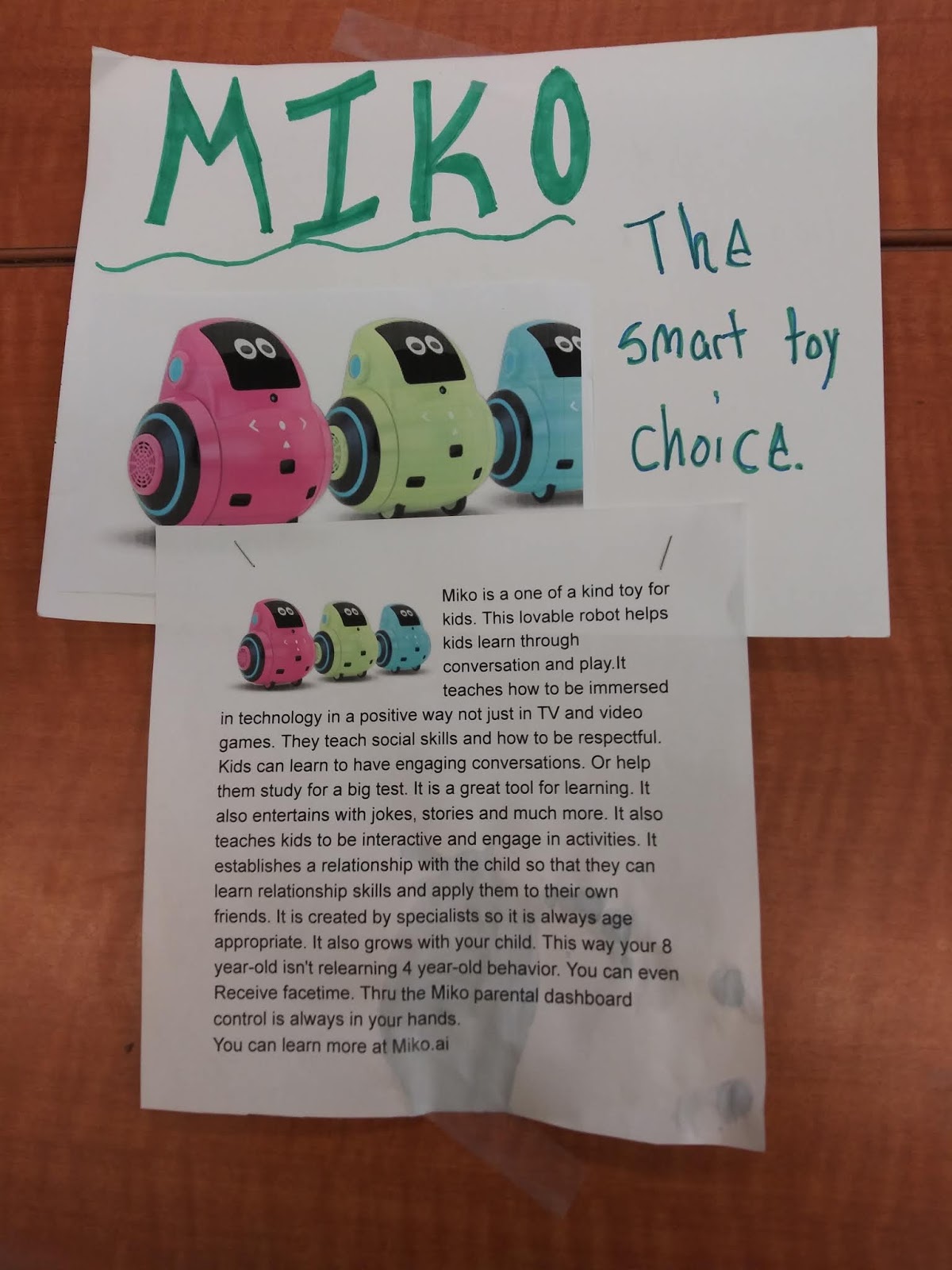
In this context the students in the first lesson considered whether they would want to have their younger siblings buy an actual 2020 product –MIKO 2 the playful robot that is a friend to younger children and gives homework help.

The students were pre-assessed about their views on this topic.  They talked about it .
Next they watched a MIKO commercial video (YouTube) and were asked to focus on how the family in the video interacted with MIKO  as well as the child and the ways the company used music and visuals to highlight the positives of this technology item that is currently for sale to all.

The students then discussed their reactions to this video and finally were given the varied project options to do, samples of which were provided.

Second Session: Ms. Xavier’s 4 classes were then discussing whether robots are useful would be cost effective in filling some job openings at their middle school, as well as the extent to which, as sophisticated middle school students they would like or could adapt to a well programmed robot instructor as sole educator or as part of a resource ICT team or collaborating with Ms. Xavier as do I.

As part of this experience They will see videos of actually in implementation, teaching robots at work with students in classrooms in different parts of the world .
The project the students will do will be a poem or story or poster or PSA/commercial for or against robots as teachers.


The three 6 th gradeclasses of Mrs. Francis, also ELA at this school, had the same lessons but not connected to literature. One of them is an ICT class with many ESL students.

Mr. Guardino is currently doing the same two parts described above with his  605  ELA class; no connection to Science Fiction.

Mr. Carideo is infusing a single lesson on MIKO into his coding and programming robotics class. also a 6th grade.

Ms.Cataldo is doing the two part topic (above) with her ESL self contained class 7th graders with a spread of English reading levels. The use of the videos made the topic immediately accessible.

Interestingly, Tte ESLstudents felt the robot could help younger siblings with English assignments and free up older siblings to do their own work.

Mark Gura, Editor


Living and Learning in an Increasingly Robot Filled World!
How teachers can engage students, grades 4 -12, in considering the education, and life impacting possibilities robots offer-
 By Dr. Rose Reissman

Look up and around you, robots are here… in school and everywhere. For ELA  teachers- video clips featuring a programmable robot toy, robot tutors and companions; and horror of horrors, classroom teaching robots; are not some slick take-off on movie fiction, but rather, recognizable, documented use of robots in current, actual use.
A growing number of secondary and elementary schools strapped for cash or short on enrollments at specific sites, have begun using robots as teachers of content and methods.  Families and educators  use robots that are very affordable-to train and support students in understanding pet and even friendship relationships.  Indeed, various companies offer what amounts to a child grade and age appropriate Siri or Alexa home assistant- always there, as is its adult counterpart, with positive reinforcement and help.

While there is no debate that these finely designed robots as teachers or as supports can immerse the students in learning content skills  with actual outcomes and if tapped at home provide the robot support that so comforts adults; is it good for a child to have a friend at the end of the day who has a set of programmable responses and moods  or will a robot teacher be able to respond to the differentiating instruction and social and emotional aspects of teaching as well as do human teachers?  Does this truly ready the child for developing human lasting friendships or short lasting ones that end with a whimper or a bang? Can a robot teacher also provide life lessons and the human connection some of today's students facing social-economic, immigrant, special needs learning and trauma in their personal lives, so need from an educator?
Does having a small portable robot who emits lifelike barks and nicely simulates small dog moves and sounds plus can be programmed to show recognition for the owner/controller, train the child to be a nurturer of a small canine or feline being who poops, emits sounds endlessly, begs, and shuts down when he or she feels like it, not the owner often controlled by the pet?

What the robots who are ALREADY here among us and a strong force, allow for – is their use as the catapult platform for engaging students in the big questions and ideas that are the stuff of deep learning and understanding and thinking so crucial to thriving in our 21st century.

These essential questions speak beautifully to students who are middle and high school or beyond, since from the level of their comparative maturity and their life experience with friendships and loss, they can evaluate the efficacy of these programmable pals and pets. They speak beautifully to all students who at the moment are overjoyed by the concept of robots they already adore from movies and Lego robotics steam course as their teachers.For middle school and beyond students:
Before viewing the digital excerpts:

Would you initially be happy to have a robot – with the same content mastery - replace your current human teacher or be part of a teacher team who already teach your class?
Explain your initial reaction and why yes or no.

If you needed help or had a question in that class with a robot teacher and a human one, which would you approach for help or to ask a question. Explain your answer.

There are  currently toys that younger children ages 5-8 can program as robot friends and as robot dogs or other pets. What would be the positives for the  children in being able to buy and to program these robot friends and pets? For each positive provide an explanation.


What would be the negatives for the children in these toys who as programmable as friends by them , would never cause them any pain as do friendships sometimes or disobey as do the most obedient live pets?  For each negative provide an explanation.

If you could buy one of these for a younger sibling or relative, would you do so?  Explain the reasons why you would or would not make the purchase.


View These Videos:
Here’s MIKO
William Recoppa on CBS 2 New York
After Viewing:   (Critical Media Viewing)
Would you want to be in William's class? Tell why or why not.  In what ways is William an effective teacher?  How would you improve William?  Why? Should William be improved?

In what ways as depicted in the excerpts, do each of the children benefit positively from the toy robot friend and the toy robot pet?

List the benefits as shown or communicated in each excerpt.

How do the media creators of each excerpt “stack” the positives to make the parent buyer want to buy the toy robot since it is not only “good” for the child, but also the family?

List these deliberate “sales” positives placed in each excerpt which is of course a commercial for the product?

As someone who is several years older than the target owner of these toys, do you find these “sales” positives convincing or not? Explain why.

Projects and Preferred Future Discussions/Explorations:
1.     ELA students can write opinion and argument essay piece point  positions on the Use of Programmable toy robots as friends or pets using their reactions to these excerpts and then one or two vetted secondary sources and asking their parents or adults.
2.     ELA students can read the prescient story “Robbie” (1940) written by Isaac Asimov which includes a girl developing a close relationship with a robot nanny who is then sent away.  They can compare and contrast Asimov’s point of view in this story with the perspective of the robot toy companies that produce these toys.  They can conclude with their personal perspectives. (Reading across print and digital genres).
3.     Students can have a podcast discussion arguing for and against programmable robot friend toys and invite PTA members, toy store owners, the school counselors, school psychologist and others to weigh in on this issue.  (Community Engagement)
4.     Students can work in an Inventions or a scratch class to design a powerful robot toy friend or robot toy dog that will be useful in helping students prepare for a human or live pet relationship. (Stem Engineering in Design Process)
5.     Students can develop “anti” robot toy friends commercials or PBAs or videos to counter these or interview younger siblings particularly those who have some form of toys like the ones shown.  (Media Literacy)
6.     Students can do market research and go through toy catalogs and ads as well as local stores to document already available and affordable toys like those in the videos and make a n online display or Power Point commenting on these various toys. (Business Marketing Research-Parcc)
7.     Students can examine how the first video seems to market to Latinos.  They can explore to what extent some of their native cultures and their America born families would never consider allowing young children to program toys as robot friends or pets. They can get family cultural and/or religious perspectives on toys as robot friends or pets.  (Culturally Responsive)
8.      Students can explore and analyze movie series such as the Transformers which certainly portray robots as human friends or consider Data from Star Trek and the famed Star Wars robot friends to consider how these unavailable in real world cinematic heroes paved the way for very affordable and programmable toys. Because  Data can be a very human empathetic pal, does that mean an eight year old should have a programmable friend whose words and gestures are pre-programmed by the eight year old and his parents? (Robots in Pop Culture).
9.     Students can enjoy creating online scratch scenarios or working with available programmable toys similar to the ones in the videos which their younger siblings have, to retell the film from the emotions or perspective of the robot toys-just as toy story is told from the perspective of non animate toys.  This creative revision of the excerpt might fictively reveal that the robot toys like the toys of toy story have “feelings: that are real.
10.  Finally in “The Veldt” (1950) Ray Bradbury portrayed two children aptly named Wendy and Peter who were so caught up in a telepathic “Nursery” immersive environment that they wished never to exit it and literally locked out their parents . The parents attempted to shut down the nursery and pull their children away from this addictive toy technology.  To what extent if any, might toys like ones in the videos, become too addictive for young children and stop them from making human friends and having barking live canine companions?
11.  Do you think within the next five years of your life there will be a mix of robot and human instructors in high school and college?  Why or why not? Use one piece of research to support your ideas.  Will you care if your instructor is a robot or a human or not care as long as you learn the material? Explain your response.
12.   Would you as career choice or as a researcher, want to specialize in robotic designs of robots as teachers or as child/teen home assistants?  Explain why you might want to do this work.
What is so intellectually rich and emotionally provocative in the discussion raised by these tech robot teachers, friends and pets, is that there is no single “correct ‘ answer for any student.  But the conversations and activities that can be generated by the robots already in prevalent use among us, are ones that are worth having and whose results may redefine teaching,  friendship and pet furrever families in the 21st century.

Staff at Ditmas Middle School involved in this project:
- Dr. Rose Reissman,  Amanda Xavier,  Dina Francis, Steven Guardino, and Mary Cataldo
- Also,  Angelo Carideo and under supervision of Marielena Santiago, 
Principal and Michelle Buitrago - Assistant Principal 
Ditmas Middle School is located in Community School District #20/Brooklyn - New York City Department of Education

Rose Reissman
is the founder of the Writing Institute, now replicated in 200 schools including PS 191 in Manhattan, New York City.  She is a featured author in New York State Union Teachers Educators Voice 2016 and was filmed discussing ESL student leadership literary strategies developed at Ditmas IS 62, a Brooklyn public intermediate school. Ditmas IS 62 is under the leadership of Marielena Santiago Principal and Michelle Buitrago AP. The Writing Institute Team are: Michael Downes, Angelo Carideo, and Amanda Xavier.

Contact: roshchaya@gmail.com


Thursday, December 5, 2019

Technology Projects with an Emphasis on “Emotional Connection”


By Dr. Rose Reissman


Often, in their enthusiasm to present activities whose goal is the learning of technology skills to their classes, teachers lose sight of how rich technology-based projects can also serve students’ needs for emotional connection and self-understanding.  

Many diligent technology teachers and their tech using colleagues from across the curriculum follow a product-driven instructional map, making certain that after a set number of sessions their students produce a rubric-aligned product. This may be a PowerPoint presentation, a podcast segment, an online video interview with a peer or teacher, or other product variety from this growing portfolio of best practice, project-based activities.

While such products are what research-driven supervisors and teachers can proudly use to validate success, as demonstrated by performance tasks - D’Acquisto, (2006), of their students’ technology skills, the students miss a powerful opportunity to ocus on. and express their individual identities and selves, as well as their cultural and community backgrounds and affinities.   While their learning products demonstrate mastery of tech skills, if that is the sole focus, then the opportunity they represent to also foster self-defining holistic personal reflection and discovery is left out of their experience.

Why Have an Instructional ‘Either/Or?’
Is there any pedagogical necessity for this favoring of one set of learning goals over the other? Or is this simply a case of over specialization, of purpose-driven myopia? Would getting the students to infuse their own personal, emotional, and cultural experience into technology focused projects derail the skills lists and accomplishments? Of course not! And very likely, students would be better engaged, motivated, and focused to learn them better.

Why focus at all on the students’ social and emotional development if what has to be shown is taken to be exclusively the tech skills taught for college. and career readiness?  Why not simply leave the students’ personal selves, creativity, cultural backgrounds and holistic development to the English, Social Studies, and Health teachers.  Afterall, that realm is theirs alone, not  that of the busy professional tech teacher’s. Or is it?

A Model of Best of Both Approaches Combined

At Ditmas IS 62 (a public middle school in Brooklyn, NYC), technology teacher, Angelo Carideo, teaches a class titled  'Technology Talent.'  Mr. Carideo feels strongly that his students’ individual, cultural, community and creative identities are key entry points on which he can focus in order to  positively impact the quality of his students’ technology learning, something accomplished through the tech products they create.  

Currently, his goal is to provide in this class ongoing opportunities for students to engage in visual art, music, and dance learning and create showcase products and performances to present to the entire school community. He explicitly focuses on the need for his participating talent students to develop showcase products which reflect their lives, cultures, and concepts of self.


Projects for Tech and Self Discovery
Mr. Carideo teaches his students to use digital cameras in order to record events around the school that reflect their own perspective. They travel around the school finding stories, shooting interviews, and taking photos of students and teachers who interest them. These become the raw material for many of their project-driven tech products. Viewed more broadly, they also represent opportunities to focus on identity and the factors that shape and influence it.

The Arts are often biographical and the way they manifest in the Tech Talent Class is a great example. Students are empowered to choose the theme of the content they will produce.  In fact, Mr. Cariedo frames the projects with the caveat that the students have to work together in teams to determine the theme they will address. This collaborative quality, too, offers opportunity to explore the world of personal identity.

In one 7th grade class, for instance, the students developed a very personal social issue theme that made for provocative podcast listening.  What resulted was very authentic, something that lead to high engagement and passion in the work of the students. So much so that after expressing satisfaction with having dealt with a self-chosen theme of a personal issue very close to their hearts and minds, they opted for it not to be made public for the upcoming, school-wide showcase.  This necessitated their redoing their podcasts with content that would still interest them, yet would not be so personally disclosing for a school audience of peers and parents.The students were happy to do this and learned valuable social/emotional lessons along the way.


Technology Teacher in Collaboration with Core Curriculum Colleagues

A favored mode of project in Mr. Carideo’s class is for students to write and stage skits that the students will also shoot video of and then upload for web-based sharing and viewing by the school community. In developing this approach he realized that the nature and content of the skit project he wanted to assign was an area beyond his tech teacher expertise; he required insight into teaching the genre in order to motivate and inform the students.
He reached out to the school's literacy coach, who ordinarily works with its ELA teachers. She supported him in developing a time travel theme which  would challenge the students to decide at this young stage of their lives whether they wanted to travel back in time to “fix” or change aspects of their pasts or travel forward in time to see their futures as adults.
Mr. Carideo was astonished at the raw, highly emotional revelations in the students' notes to their past younger child selves.  These notes detailed things like regret for not being kinder to dying grandparents or enjoying happy moments with adults who had left their lives. The wisdom of some of these eleven year olds in realizing that changing the past is not a good idea was also noteworthy.  The drawings the students made prior to using the technology made the final, tech-based products that much richer for the students emotionally. Having the art work to incorporate and add emotional color enhanced their technology platformed projects considerably.

Another approach that Mr. Carideo favors involves having his students discover the impact of global, cultural geography on their lives. Aware that his Title 1 students have limited opportunities for travel, Mr. Carideo showed them how to use Google Earth and online video research to provide a setting for a fantasy travel 90 second, mixed-media video with voice recordings, music, and  Google Earth-derived background images to present to a school assembly from the auditorium stage. 

Mr. Carideo wisely began preparing his students to create these showcase products by having them share geographic regions they had visited as part of family “native homeland” summer trips and finding these online as videos or maps or informational narratives.  The students enjoyed researching these sites and some other exotic ones from their seats as a rehearsal for their own informational presentation set in these sites. They would use the projection of their researched footage as a backdrop for their sketch. The result of their passionate work on these products included not only acquiring a handful of sophisticated technology use insights and skills, but deeper understanding of their own backgrounds and pride in sharing them with their community of peers.

For another project the literacy coach suggested using a walk home from the school building, an experience shared by all middle school students at this neighborhood school in Kensington Brooklyn. Google Earth made the walk come alive and memorable for the students and, of course, added a rich level of sensory data to their writings and visual art.  These they drew on in creating podcast readings of their writings about this walk- memoir.

This project supports the students in demonstrating spoken and written fluency; it’s an activity anchored in Jason Reynolds’s Look Both Ways.  If this activity were presented purely to teach podcasting skills and use of Google Earth what would be overlooked would be the very meaningful focus on student individual school walks as an exploration of their personal and community lives.
It’s About How Tech Projects Reveal the Personal, Individual Side of Students
Every successful tech learning program ultimately needs to succeed with special needs and ESL learners. ITo ensure this Mr. Carideo makes certain to get to know his middle school students as individual persons and as talents.  As an example, with a 6th grade class, Mr. Carideo observed how one student, Jayson, was able to make artisan DIY figures from pipe cleaners and yarn.  Each was vibrant and distinctive.  Jayson was able to talk about each of them.  Mr. Carideo had Jayson interviewed, as though he were a noted crafts artist, by a peer holding a mike to whom Jayson explained, his process step by step, . 


Mr. Cariedo found out that the class had studied the popular book “Wonder” with their ELA teacher. Accordingly, he had the students use, as their podcast topic, whether or not a student with cranial facial anomalies should be home schooled or not; in the book, the character Auggie has had 27 plastic surgeries, The students knew what being different meant in the context of the story and their own lives.  Thus, a tech skills oriented project, by dint of carefully selected focus content, facilitated through cross discipline study and teacher to teacher collaboration,yielded a Social and Emotional Learning-rich experience for the students.

Ultimately, as all true arts talent educators and tech educators realize, the desired and hoped for outcome lies not so much in the rubric evaluated quality of the student products, but in the palpable transformative evolution of the student as an informed, caring, expressive person.  Toward this goal educators like Mr. Carideo realize that the powers of technology to make an emotional and holistic connection are waiting to facilitate deeper and more meaningful student experience. 

……………..


Angelo Carideo has been at Ditmas IS 62 for 17 years. He is part of the Software Engineering Program Team. This school year 2019 2020, he developed the new Tech Talent program that he teaches. Its goal is to use technology skills and tools as an integral part of producing showcase products tapping students’ talents and social and emotional learning abilities.

Ditmas Is 62 is a neighborhood intermediate school in Kensington, Brooklyn, NYC District 20. It has over 1,200 students enrolled - over 13 percent ESL students, in addition to special needs students and regular education classes. Each grade has enrichment classes. The school is a leader in SEP (Software Engineering Program, a NYC technology initiative) and has always focused on developing student talents. This is its first year to offer a Tech Talent class. There are over 1200 students enrolled at Ditmas.
Marielena Santiago is the Principal of DITMAS.  Olivene McIntosh is the Assistant Principal in charge of SEP. 
............................................................................................

Dr. Rose Reissman is the founder of the Writing Institute, now replicated in 200 schools including PS 191 in Manhattan, New York City.  She is a featured author in New York State Union Teachers Educators Voice 2016 and was filmed discussing ESL student leadership literary strategies developed at Ditmas IS 62, a Brooklyn public intermediate school. Ditmas IS 62 is under the leadership of Marielena Santiago Principal and Michelle Buitrago AP. The Writing Institute Team are: Michael Downes, Angelo Carideo, and Amanda Xavier.

Contact: roshchaya@gmail.com


Friday, November 15, 2019

How Mary Poppins Helped Our Middle School Book Study

This Middle Web article was inspired by an article first appearing here in Literacy Special Interest...
http://literacyspecialinterest.blogspot.com/2019/03/mary-poppins-pops-into-21st-century.html

"How a Spoonful of Sugar Helped Our Book Study

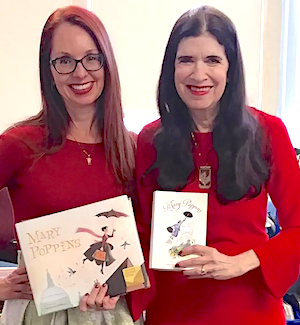
Amanda and Rose
By Rose Reissman and Amanda Xavier
Reading and studying books is a perennial classroom activity; one that may be experienced by students as sheer drudgery or one that can be engaging, exhilarating, and satisfying.
Which variety of experience teachers offer depends on which book is selected and how it is taught.
Over the years we’ve cracked the code for implementing book units that have our middle grades students enthralled, with imaginations fired up, and looking forward to future book studies when the unit is over.


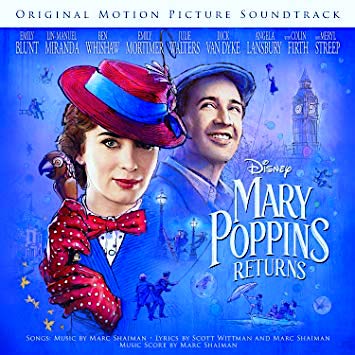
One part of our approach is to select a book that is associated with current pop culture movies, like the popular Mary Poppins Returns released last December.


Most young people love to read about magical characters who can fix the negative realities described in a story. This is a classic theme across literature, including adult books, but an especially strong and beloved technique in books written for youngsters.

Magical characters like Peter Pan who fled a negative world to a never-never land of childhood win devoted audiences for their authors. Mary Poppins is a defiant “life fixer” who swoops in with empathy and wise guidance and precipitates magic and joy. She is also softer and less violent than the many modern-day popular characters like Marvel superheroes. She offers tenderness and hope for students.

Why Mary Poppins?

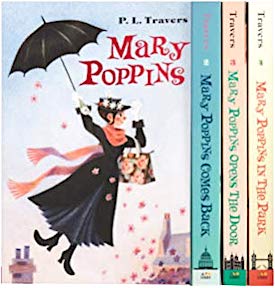
Mary Poppins has a long history of being a much-loved character.  She was introduced back in 1934, after then-actress and journalist P.L. Travers spent some convalescent time developing a simmering idea into her first novel.
Many adults involved in today’s students’ lives know and are nostalgic for Mary Poppins, making inter-generational sharing of the book series and movies an especially rich experience.


from Mary Poppins – The Musical (Study Guide)

The 2018 film, Mary Poppins Returns, with musical and visual references mirroring the original and internationally known 1964 version, traces a complex lineage all the way back to 1934 when the first in a series of eight Mary Poppins books was published and became a perennially favorite piece of young people’s literature. Australian-British writer Travers kept the series going through 1988.
When trailers for the Mary Poppins Returns movie were released, Rose immediately sensed that there was a potentially rich teachable moment unfolding. As a child Rose had read the print book and liked the independent nature of Mary Poppins who did not take orders from her employer. Amanda was also a fan of the print character as a child. We both loved the 1964 movie as did many of our colleagues who grew up in the late 80’s and 90’s.


The fact that there is an extensive body of work on this appealing character and her ever unfolding story –  and also that so much of this is in digital format, online, and free and easily accessible for teachers everywhere – makes the Mary Poppins theme all the more significant to teachers who are willing to take a chance on a classic storyline.

Consequently, we sat down, planned and implemented the following activities with Ms. Xavier’s classes of sixth graders at Brooklyn’s Ditmas Junior High in Brooklyn, NY. The result was so successful, the students so fired up and engaged, that we wanted to share some details with colleagues who may wish to implement some or all of it as we did. If Mary Poppins is just not your cup of tea, perhaps you’ll distill some ideas from our planning and apply them to other themes.

A “Book” Is More Than a Book

One of the important leaps that literacy educators are currently making is transforming their practice to embrace the concept that “book” means more than simply many pages of text-bearing paper bound between two covers. And by “more” we don’t mean simply a downloadable e-book version.
Rather, the 21st century book embraces a synergy of numerous contemporary content formats – web published text, online video and audio, and more – all working with one another to produce a single, engaging, media rich experience.


Which brings us to the 21st century classroom. As is laid out perfectly in the UDL (Universal Design for Learning) body of theory, teachers should engage readers by addressing their wide variety of needs and styles through flexible and varied content formats. These may include moving and still visual elements, dramatic film sequences, the music and lyrics of songs, as well as print text.
In view of this new understanding of books, and the fact that we were much taken with the popularity of the original movie and the strength of the original novel as a focus for book study, we planned a unit on Mary Poppins.


Interestingly, we did not have access to multiple copies of any of the Mary Poppins books. We decided to present our students with a rich Mary Poppins experience anyway, using some of the free and easy-to-access digital resources available.

Here’s Some of What We Did

Introducing the Mary Poppins theme was accomplished by having the students view several of the very accessible and short movie trailers found on YouTube. These are perfect for short, 50 minute classes and, importantly, these are so skillfully produced that even though they are only 4 to 7 minutes long they motivated our students to move on to content provided in other more challenging formats.
MiddleWeb SB
Prior Knowledge Pre-assessment
The night before the lesson we had students ask their parents and family/friends what they knew about Mary Poppins and talk about their experiences with her. We had them write and date their pre-assessment, sharing what they discovered. We allowed them to discuss their responses and their parents’ connections to Mary without commenting ourselves.


Among other activities, we challenged them to reflect on what a nanny does and if there are jobs like this around today. You may want to share the GoNannies website after the activities to solidify and extend the conversation.


We told the students that a British author wrote this story and a series of other Mary Poppins books, beginning back in 1934, almost 100 years ago. We had some discussion: given that there are many successful American authors writing today, should they be studying this work, or would a work published currently be a better focus?


We asked those who enjoy art to draw the Mary Poppins character. We helped them to define her in art as a character by asking what dress and accessories she always has. These include: umbrella, hat, kite, carpet handbag, etc.


We returned to this pre-assessment discussion at the end of these activities and had the students share what they learned from this start.
Reading across various formats
A great activity to get students to think about plot, plot sequels, and the flow from one to the other is to have them read the beginning and end of a book and predict a sequel or prequel. While a class set of the books on which the 1964 movie is based may not be available, the movie itself can be found on DVD or streamed.


Since the Mary Poppins Returns movie (2018) is a sequel to the first Disney film done in 1964 and Mary Poppins Comes Back (1935) was the actual print sequel written by Travers, we had students review the last page of the first Mary Poppins book (1934). Large segments of both the original book and the first sequel are available online at Google Books. Students can also look at the 1964 Disney film script and read the final pages to inspire a plausible sequel given the last lines.


Our students then wrote a beginning of the print sequel. They storyboarded their ideas of how to create a sequel from the known ending given in the original book, but a purely text outline would suffice.


Of course the writers of the 2018 film created their own sequel, but our writing activity pushes kids, as engaged readers and writers. Explain to the students that by working from the original’s last page, multiple beginnings of the sequel are possible and it is very likely that the writers of the new movie created and debated many possibilities before selecting the one that made it into the movie.

Other possible activities

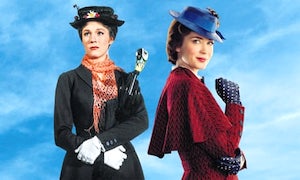
Our students had not yet seen the new Mary Poppins movie (released in December 2018) with Emily Blunt and Lin-Manuel Miranda, so this idea worked well for us. It’s a strategy that might be used with other classic book-related films that are being updated before the new versions are released.
We showed the students the 4-minute online trailer of the original 1964 film available at YouTube. We asked them to watch for things they thought might be needed to update this movie for the sequel. Should it be switched to the United States? Should it take place in the 21st century? Should Mary’s wardrobe be updated to have different fashions? Should the same main characters be used or different ones, perhaps related in some way to the same characters?


We allowed them to talk about their choices and told them that even if the writers of the film they were eventually going to see did not use ideas like theirs, they were exercising their own creative thinking skills.

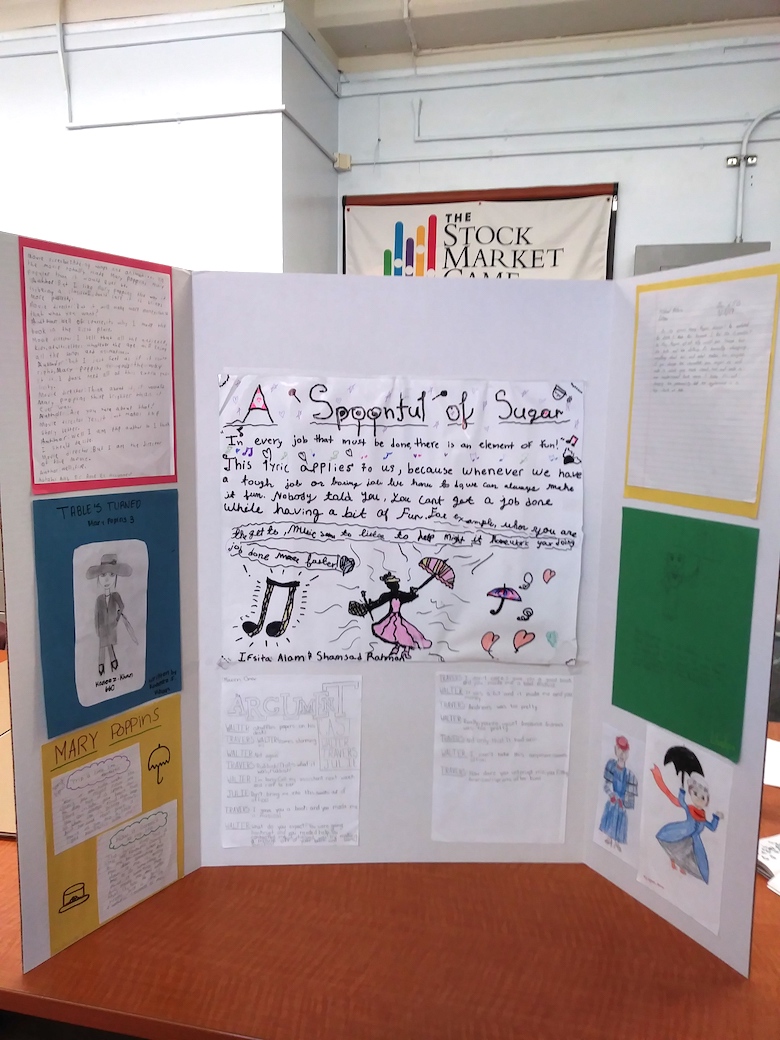
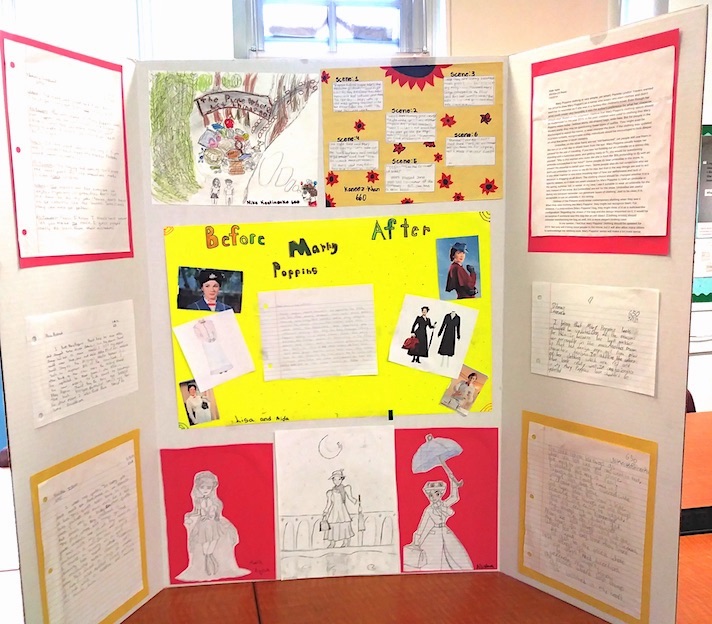
We then extended the discussion by showing them several trailers from the upcoming Mary Poppins Returns (see here and here) and talked about them in the context of our various activities. Some students did “before and after” display boards to share what they learned with other students in our school.

Long live Mary Poppins!

Consultant Rose Reissman: Who says Mary Poppins can’t be the practically perfect character for 21st century kids’ literature – or at the very least, the focus of their passionate arguments about her?
The strategies suggested here focus on our use of free digital trailers and accessible recordings of songs and interviews that can help introduce today’s students to children’s classics of the past. This is both a cost-effective way to acquire an abundant body of rich instructional materials, as well as a way to introduce today’s audiences to great works of the past.


We also like using a visual entry point to motivate and generate interest in the print text. Whatever PL Travers may have thought about them, the film versions of Mary Poppins will help assure ongoing popularity of her print books.


Teacher Amanda Xavier: Harkening back to days of yore has a certain appeal as we grow older. But does this have a place in the modern ELA classroom? Should students be introduced to older works of fiction, or should the emphasis be on modern tales that encapsulate modern dilemmas and ideals?


I tend to use more up-to-date books with my classes, mostly because I get tired of doing the same old thing year in and year out. So imagine my surprise, while working with Dr. Rose Reissman, about the enthusiasm my classes showed to creating responses to Mary Poppins.


If any book is dated and out of touch with contemporary kids in a Brooklyn middle school, Mary Poppins would seem to be it. But my kids loved her. Really loved her.


The visceral connection many felt to the lyrics we showed from both movies was amazing. The kids got her. The simple lessons of picking yourself up, dusting yourself off, and getting out there again – or the sentimentality of a slow, sweet song – was not lost on them. They enjoyed creating storyboards for the beginning of Mary Poppins Returns and were great at it.


So yes, everything has its day and then passes into nostalgia. But if a very old fashioned nanny can bring smiles and make modern kids sit up in class and take note of her very topical lessons, I say, “Cheerio, Mary Poppins.”

As part of Amanda Xavier’s Mary Poppins Enters the 21st Century Project, students were asked to compare and to contrast the various moods, tone, and film styles of the 2018 version of Mary Poppins versus the 1964 version. Read their astute filmgoer responses here.

More Online Resources
Mary Poppins Chatterbooks resources (UK – PDF) 
How Mary Poppins Returns reinvents the beloved nanny for the 21st Century
How to Write a Nanny Job Description (FullTime Nanny website)
Lin-Manuel Miranda Shares What Being in Mary Poppins Returns Means to Him
___________________________________
Dr. Rose Reissman is the founder of the Writing Institute, now replicated in 200 schools. This project was developed with students at Ditmas Junior High (IS 62) in Brooklyn NY, led by Principal Marielena Santiago and Assistant Principal Michelle Buitrago. The Writing Institute Team includes Michael Downes, Angelo Carideo, and Amanda Xavier.
Amanda Xavier is a New York State permanently certified Common Branch K-6 teacher. She began her teaching career in 2001 in Brooklyn, NY where she taught all subjects in 5th grade for five years. She’s been teaching 6th grade ELA since 2006.